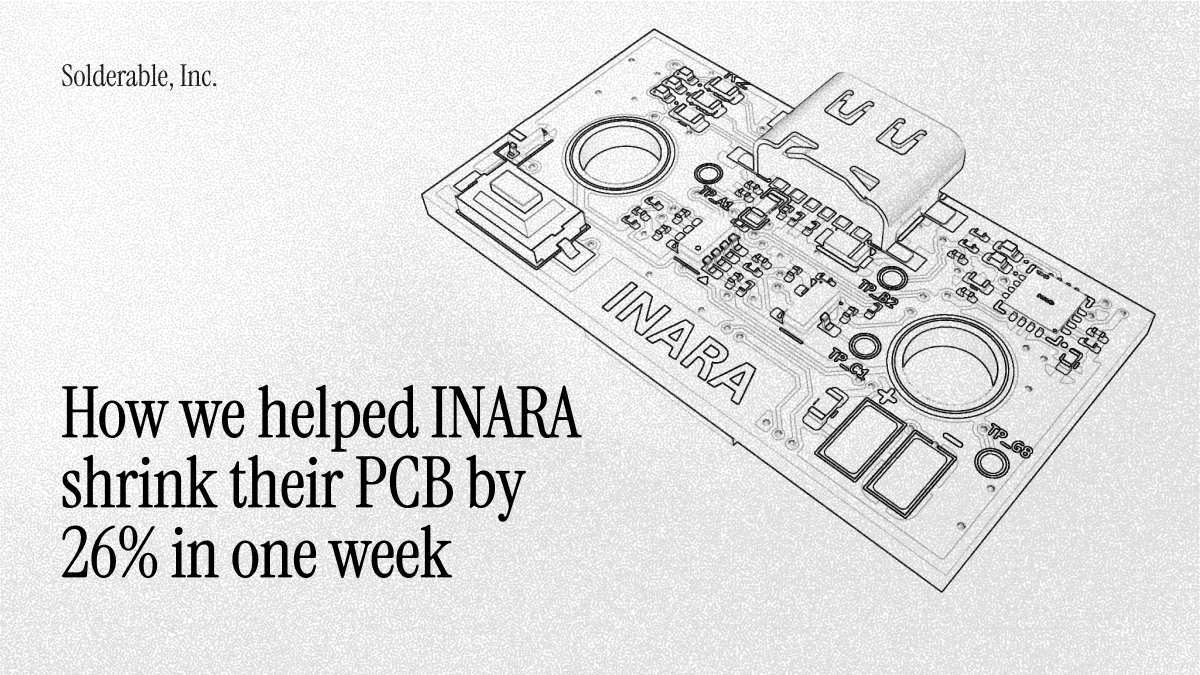
Building faster hardware together: How we helped Inara refine their wearable
2025-10-15 · Daniel Liu
When we first met the team at Inara, they were in the middle of developing something genuinely exciting: a wearable device that helps gym-goers and personal trainers understand how their muscles are performing in real time.
Their device can detect fatigue, muscle activation, and asymmetry, giving data that normally only comes from lab-grade equipment. It’s the kind of product that bridges the gap between human performance science and everyday training.
Inara is part of the Founder's Inc Blueprint program, where they’re building their next-generation hardware platform. When they reached out, they had a working prototype but wanted help taking it to the next level: smaller, more reliable, and ready for real-world testing.
pssst, you can drop a pre-order if this sounds exciting to you.
Figuring out what mattered
Early on, we sat down to understand what really mattered for Inara’s use case. Wearables live and die by comfort and consistency. If it’s too big, too heavy, or unreliable during workouts, it won’t make it into someone’s gym bag.
So we made a list:
- shrink the board size without sacrificing signal quality,
- make the power system more reliable,
- simplify assembly for quicker iteration.
That became the foundation for the redesign.
Using AI to speed up the grunt work
A lot of PCB design time isn’t spent on creativity, it’s spent on logistics: finding components that are in stock, verifying footprints, cross-checking specs, and re-routing when something changes.
We’ve been building internal AI tools to automate some of that, and this project was a great test case.
- Our sourcing agent scanned multiple distributors and suggested replacements that met Inara’s specs and availability constraints.
- A system-design workflow flagged power domain overlaps and voltage margin issues before layout.
- Schematic drafting was partially automated, so we could focus more on high-impact layout and signal routing decisions.
Those tools didn’t replace engineering judgment, but they gave us a head start, letting us go from requirements to Gerbers in just one week.
The outcome
By the end, the new design was 26% smaller, with a refined form factor and more efficient power system. It was easier to assemble, easier to test, and more comfortable to wear.
We didn’t need a massive re-architecture, just a series of focused decisions: cleaner routing, smarter component choices, and tighter collaboration between mechanical and electrical design.
What we learned
This project reinforced a few lessons that might help other teams working on early-stage hardware:
- Speed comes from clarity. We made fast progress because everyone agreed on what mattered most before layout even began.
- Automation helps, but collaboration still wins. The AI tools saved us time, but the biggest time-saver was clear communication with Inara’s team.
- Iterate like software. Hardware doesn’t have to move slowly. With the right tools and mindset, you can still iterate weekly, not quarterly.
Looking ahead
Inara is pushing the frontier of what’s possible in the gym, giving trainers and athletes real insight into how their bodies work. For us, this project was a reminder that AI-assisted design isn’t just about efficiency, it’s about enabling more teams to move at the speed of their ideas.
If you’re building something new and wrestling with how to get from prototype to something you can ship, start by tightening the feedback loop. The faster you can learn, the faster you can build.
- Daniel